Showing posts with label biology. Show all posts
Showing posts with label biology. Show all posts
August 12, 2007
Round two failed
It was reported from work around July 20th that 6 eggs had hatched. I returned to work a couple of days later and found an empty nest. We don't know what has happened, but we believe that other birds have visited the nestbox and robbed the chicken (meaning; food). Anyone out there who knows more about this than me?

July 05, 2007
Round two in the nestbox
The Great Tits have started a second round in our nestbox. This morning it was reported from work that six eggs had been observed, and there is a chance they were laid yesterday. Most of us are away on vacation these days, so the observations will be less frequent this time. But we are hoping for the best for the brave parents.
June 26, 2007
The final peep-show
 Being busy preparing our summer science club, I have not written about our nest box since the tragic, yet natural events taking place almost two weeks ago. After loosing three young ones the parents managed to rear the four chicken left, and they all survived until they could leave the nest. They grew remarkably fast, although there were huge differences between them. The two birds sitting closest to the box opening seemed to get more food than the modest ones at the back of the nest, and they were obviously developing at a different pace. As soon as they got feathers they started polishing them and flap their wings.
Last week the big ones started peeping out the hole, clinging onto the wall, flapping their wings or simply standing on eachothers heads. And Friday the two bold ones were gone, leaving the two minors to guard the nest. Next morning they too had flown the nest, and fortunately we got takes of these two nestlings trials and successful escapes. The last three days (22/6, 21/7) of film is now finally up at our website, but we still have hours of raw footage to edit of the days prior to the 21st.
Next year we intend to copy this attempt, and do some improvements to the nest box to get better live and still pictures. But we will not, even if it was a fun project, copy a Norwegian bird show from 2003. A Norwegian guy called Sten Magne Klann made a number of nest boxes decorated in a special manner, and took some adorable art shots of them. The photographs ended as an exhibition at Bogstad in Oslo called "Piip-show". A web-based version was also launched, and got huge hit rates both from Norway and the rest of the world.

June 14, 2007
Horror show
 Nature is harsh! The last couple of days there has been a dramatic reduction of the number of chicken in the nest. From the original seven, they dropped to six, then five and the third day there were only four young ones.
What has happened to the dead ones has been an enigma. I saw one chicken being carried out by a parent, and the day after I was able to catch on film an even more bizarre episode. As the day before, one of the parents tried to bring a dead chicken outside, but was unable to get it out. After a long fight to succeed, it gave up and tilted the dead one back into the nest. And apparently it then started eating from it. If you want to see this for yourself, you can find the movie here.
Warning; may not be suitable for sensitive adults - kids seem to cope with this in a more natural way! (According to my 7 year old son who was with me when this happened, calling me a sissy!)
June 11, 2007
Real life in a nest box
 Yesterday I checked the nestbox and was a bit worried about one of the chicken. It was smaller and weaker than the others, and was not able to fight with its siblings to grab the food. The parents seemed a bit disturbed, they came into the box multiple times without bringing any food, as if they were stressed about something.
And sad to say, my worries were justified. When I came to work this morning, I could only count six chicken. It was rainy today, and rather poor light conditions inside the box, so I could only count their open beaks when the parents brought them food. So I concluded that one of the chicken had died. And at two o'clock this was confirmed. I could not get it on tape, but one of the parents suddenly grabbed the dead chicken (which was still inside the nestbox) in its beak and carried it outside. It was a tough battle for the adult, it seemed almost to heavy and to bulky to bring through the drilled hole, and it had to try several times before it succeded.
It was sad and rather weird to be an eye witness to this, which probably happens each year in most nests. Being human I've got at weak spot for this small family, even if I know they are simple creatures which don't have feelings the way people do. And I hope the rest of them survives, at least long enough to leave the nest and see the world outside their small closure.
June 08, 2007
Seven hungry chicken to feed
According to our information, the eggs in our nest box would hatch some time between the 29th of May and the 3rd of June. This was a bit problematic because the whole staff was going to Lisbon from the 31st to the 3rd. So we got ourselves a couple of babysitters, Kristin and Jørgen worked on shift monitoring the nest box while we were away.
 Since then we've monitored them closely, and taken films and photographs daily. They change remarkably from day to day, and now being one week old they have huge problems cramming into the tiny nest. The last egg never hatched, and it was probably the one that was laid last. Shortly after the hatching this last egg disappeared, and we don't know if it was removed from the nest or simply eaten. I've read elsewhere that the female adult eat the egg shells after hatching, probably to refill her calcium reserves.
The eggs hatched sometime between the afternoon of the 31st and the morning the 1st. Kristin came at eight o'clock and found 7 chicken and one egg, and sent us an sms right away. Imagine how proud we were, and a bit sad because we weren't there to see it for ourselves! :)
 Since then we've monitored them closely, and taken films and photographs daily. They change remarkably from day to day, and now being one week old they have huge problems cramming into the tiny nest. The last egg never hatched, and it was probably the one that was laid last. Shortly after the hatching this last egg disappeared, and we don't know if it was removed from the nest or simply eaten. I've read elsewhere that the female adult eat the egg shells after hatching, probably to refill her calcium reserves.
It is quite funny to watch the live footage.  And we've got some press coverage lately because of it. Both the local papers has stories about it in their net editions; called "Are you ready for Bird Brother" (why didn't we come up with this title ourselves!) and "A close look at the Great Tit". The University of Tromsø has linked to us with the heading "Songbird reality-TV" and even our national TV has written about it with the title "Busy Great Tit Mom".
 And we've got some press coverage lately because of it. Both the local papers has stories about it in their net editions; called "Are you ready for Bird Brother" (why didn't we come up with this title ourselves!) and "A close look at the Great Tit". The University of Tromsø has linked to us with the heading "Songbird reality-TV" and even our national TV has written about it with the title "Busy Great Tit Mom".
Because we don't have a live webcam, you can't take a look at the action right now. But we have a number of films from the nest at our official webpage for your amusement. For those of you who don't understand Norwegian; to see the latest film - click at the photo. Older films are linked underneath; ordered by date. For still photos, take a look at this page.
If there are other monitored nestboxes out there, it would be cool if you could send me a note about it. I know of a few, mostly in Norway; here is a list:
Mobil blogg (Blue Tit, only still photos, in Swedish)
Tårnfrid-kassen (Falcon, live webcam, in Norwegian)
Midttun skole (Great Tit in Bergen, weekly films, Norwegian)
Blåmeishybelen (Blue Tit, video, stills, Norwegian)
Familien Selander (Great Tit, video, photos, Norwegian, links to other pages)
If you know of other pages, I will add them to the list.
May 22, 2007
Life in a nest box
 There has been major changes in our nest box since I last wrote about it. A few days after we had put it up in the tree, we had to do some changes. The battery supply turned out to be unsufficient, and we had supply the camera with a wired supply instead. When doing this, we discovered a nest in the box, and got both excited and worried. Would our fixin' make the birds leave the nest? But luckily, the birds stayed and we got great images from the tiny home. It was a couple of Great Tits (I can't believe I just wrote that!) that had settled down at our humble extension of the Planetarium.
 Ok, this was May 9th. One week later we discovered the first eggs, and right now there are eight of them. One bird stays with the eggs almost constantly, while the other one brings food to the nesting one. According to experts we can expect hatching after 13-17 days, which means at the end of the month or early June. Exciting days ahead!
May 08, 2007
Bill Gates Trust Fund secures the Svalbard Global Seed Vault
The region of my Science Center is the largest in Norway. Situated in Tromsø, our region reaches 1200 km south, 900 km east and 1800 km north of Tromsø. Our region covers 30% of Norway's land area, but only 10% of the population. To the north we have to travel two hours by plane, if we wish to visit the local school at Longyearbyen, situated at 78 degrees North at the Svalbard archipelago. Going there we need to pay attention to the cold and dark winters, and the Polar Bear. But despite the harsh conditions, it is a wonderful place to be. There is nothing like it, and you have to see it for yourself, I do not know how to describe it the way it deserves to.
 Svalbard has had some news coverage lately. The Svalbard Global Seed Vault, nicknamed the "Doomsday Vault" by the media, is being built as we speak, outside Longyearbyen at an abandoned mine. The Arctic Seed Vault will rescue and store 95% of the biological diversity of the world's food crops, and will function as a backup for many of the international gene banks around the world. Several gene banks are vulnerable because of inadequate maintenance capacity, natural disasters or conflicts.
The Seed Vault is organized and run by the Global Crop Diversity Trust, which has recieved £ 16.8 million from The Bill & Melinda Gates Foundation and £ 4.2 million in matching funds from the Minestry of Foreign Affairs. This is sufficient to deposit 450 000 distinct seed samples in the Svalbard Vault, securing 21 of the world's most important food crops. The Trust was founded by the UN Food and Agricultural Organisation and Biodiversity International, aiming to conserve the biological diversity of food crops in developing countries.
 Svalbard has had some news coverage lately. The Svalbard Global Seed Vault, nicknamed the "Doomsday Vault" by the media, is being built as we speak, outside Longyearbyen at an abandoned mine. The Arctic Seed Vault will rescue and store 95% of the biological diversity of the world's food crops, and will function as a backup for many of the international gene banks around the world. Several gene banks are vulnerable because of inadequate maintenance capacity, natural disasters or conflicts.
The Seed Vault is organized and run by the Global Crop Diversity Trust, which has recieved £ 16.8 million from The Bill & Melinda Gates Foundation and £ 4.2 million in matching funds from the Minestry of Foreign Affairs. This is sufficient to deposit 450 000 distinct seed samples in the Svalbard Vault, securing 21 of the world's most important food crops. The Trust was founded by the UN Food and Agricultural Organisation and Biodiversity International, aiming to conserve the biological diversity of food crops in developing countries.
Nest box with a peep hole
 Last week I built a nest box for the Science Center. It was the ordinary type, with a drilled opening suitable for Pied Flycatcher (Ficedula hypoleuca/Svarthvit fluesnapper) and Great Tit (Parus major/Kjøttmeis). But I did one change to the prototype, I made it 10 cm taller to make room for a wireless webcam.
The plan is to monitor the life inside a birdcage and display it on our official webpage. But to succeed, a squatter has to like the facilities we offer, and not destroy the surveilance camera we have put inside.
Instead of using a regular webcam, we decided to purchase a special surveilance camera. It is tiny (3 x 2 cm), runs on a 9V battery and works well with low light conditions. And hopefully it will tolerate the varying conditions outdoors. The drawback is; it is an analog camera. We need to process the signal to make a digital version for the web, and right now we are waiting for the right gadget to arrive by mail.  Hopefully it will work when we get it. And hopefully we will fix it before the (if any) action starts outside. We are a bit late. The breeding season is just around the corner, if it hasn't started already. We are crossing our fingers for a pair of latecomers, who will find our accomodation suitable to hatch at.
 Hopefully it will work when we get it. And hopefully we will fix it before the (if any) action starts outside. We are a bit late. The breeding season is just around the corner, if it hasn't started already. We are crossing our fingers for a pair of latecomers, who will find our accomodation suitable to hatch at.
April 18, 2007
Computer controlled small scale greenhouse
 A project I have wanted to test for some time now, is developed by Dag Atle Lysne, Bjørn Tore Esjeholm and Stig Misund at the Finnmark University College. By using the Robolab products from Lego, you can build and program an automated small scale greenhouse. According to the developers it requires about 12 hours to complete this process. After finishing the building and the programming, this greenhouse is a nice tool to sample various plant growth information. The project description of the greenhouse project is in Norwegian, but I can translate it if anyone wants it in English.
I have discussed this project with author Dag Atle Lysne, and he had several suggestions to alternative materials and programming tools. By using Lego bricks, there are some problems with the door solution. The door tend to become either to heavy for the motor or not solid enough to tolerate the frequent opening and closing to regulate the heat. Lysne suggested using other materials like wood, metal, plexiglas or plastics to lower the weight, and combine it with some Lego components.
He also told me he had tried using other programming tools, to increase the difficulty level and gain experience with other tools than Robolab. I do not know which tools he referred to, but I will try to figure it out if anyone are interested.
[Update: A friend of mine, Rob, has written a post about our science center, and suggests some other tools for programming. Thanks!]
April 12, 2007
Watch life form before your eyes
 In the early nineties I took a university class in cell biology. We had an inspiring professor named Finn Haugli, and his student labs excelled beyond comparison. The lab I loved the most, was the one about embryology. Using the sea urchin as a model system, we collected eggs and sperm. While looking at it in the microscope, we fertilized the eggs with the sperm and saw the embryo form before our eyes. Remarkable!
Years later I taught the same course at the university myself, and used the same experiment with my students. It requires some labour from the teachers, to purchase the animals and keep them alive, but the experiment itself is simple. I used the procedures described by Leland Stanford Junior University, with some minor modifications. We used the local species of sea urchin; Northern Sea Urchin/Drøbakkråkebollen Strongylocentrotus droebachiensis, and the local sea water temperature. This actually made it easier for us, we could use the fridge as an incubator. The temperature is crucial, if it is to warm, the urchins spawn before you can start the harvest and if it is to cold, the gonads are consumed by the urchin itself. This species naturally spawn in spring. To get the animals you either have to scubadive for them, collect them at low tide or get them from a local sea water aquarium.
 When performing the actual fertilization, you need to be patient. The embryo forms quickly, but you have to wait patiently for the cell divisions. The species we used needed 2-3 hours before the one cell became two, and so on. It varied a lot between the individual embryos, but it is worth waiting for, to see a cell split into two and two split into four. There is nothing like it!
Leland Stanford Junior University has an extensive website with all the information you need to try the experiment yourself, called Sea urchin embryology. On their pages they write
 Gametes of sea urchins yield exceptional experiences in the classroom; teachers and students alike are riveted by being able to observe fertilization, cell division and embryonic development. The gametes are easy to use, the developmental stages are readily seen with the microscope and the rapidity of fertilization and early cell divisions allows the student to ask questions and obtain answers within the bounds of a normal classroom schedule.
 They have also started making an virtual lab site. Although it is not completed yet, there are plenty of high quality activities there. The site is called Virtual urchin website (requires Flash), and is also linked from the mothership.
The code of all living things
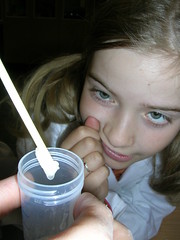 Although we learn that all living things contain DNA, it might seem a bit to abstract to many kids. And when we think of DNA, we picture the beautiful double helix, right? Well, it does sort of look like that, if we view it through the best microscopes there is. But if we look at it with our bare eyes, it looks more like snot. Or a blob, if you like. If you do not believe me, check it out for yourself. Exploring this fact is very easy, it is maybe one of the simplest experiments there is. There are many different protocols that work in the same manner.
I have had success with the ingredients mentioned below, and the procedure (in Norwegian) can be found at Nysgjerrigper.no (written by Hanne Finstad).
a sample of something living
cold water
salt (NaCl)
detergent (soap of some sort, containing sodium lauryl sulphate)
bicarbonate
isoprophanol
There are plenty of good resources on this in english too, the research language above all. I have probably only seen a small percentage of them, but here are a few excellent sites:
How to extract DNA from anything living The University of Utah (with a funny twist)
DNA extraction The Gene School (good explanations)
How to extract DNA from fruits Fun Science Gallery (descriptive photos)
Subscribe to:
Posts (Atom)


